The OpenBody Canon
Every serious industry or intellectual movement eventually discovers that it needs a canon.
Biology has its Watson–Crick–McClintock ladder. Chemistry has its own lineage: Pasteur, Pauling, Venter. Even the modern open-source software movement has a canon: Stallman's GNU Manifesto, the Creative Commons framework, and the loose constellation of essays and zines from "A Cypherpunk's Manifesto" to Molecular Biology of the Cell, that taught a generation of tinkerers what "life itself" looked like as a design space.
They are the shared narratives that tell practitioners what the field is trying to achieve, which problems matter, and which failures were heroic attempts rather than simple missteps.
The Open Biology movement (what some may call "biohacking") now need that same clarity. And yet, when I try to articulate our canon, I find myself walking through fog.
I haven't yet been able to articulate the full ethos we're aiming for, but the pieces below are a start. They inform how I think about open biology and why OpenBody exists. They are the first vertebrae of the spine we're building, and the canon that follows is an invitation to walk that spine with me.
A Bill for the More General Diffusion of Knowledge
Thomas Jefferson, 1779
Thomas Jefferson believed that power and knowledge were the same thing, and that concentrating either in the hands of a few was how liberty died. In 1779, he drafted a bill for the Virginia legislature proposing something radical: that knowledge should be actively diffused throughout the population, not as charity, but as the structural precondition for a free society. "Enlighten the people generally," he wrote, "and tyranny and oppressions of body and mind will vanish like evil spirits at the dawn of day." The bill failed. But the argument it made has never stopped being true, and it belongs at the top of this canon because it names the enemy clearly. The threat to self-determination has never been violence alone. It has always been the deliberate maintenance of ignorance, whether about politics, medicine, or the biology of one's own body. Jefferson's bill was about education. This movement is about something adjacent: the insistence that the knowledge required to understand and govern your own body is not a privilege. It is a right.
The Self-Experimenters
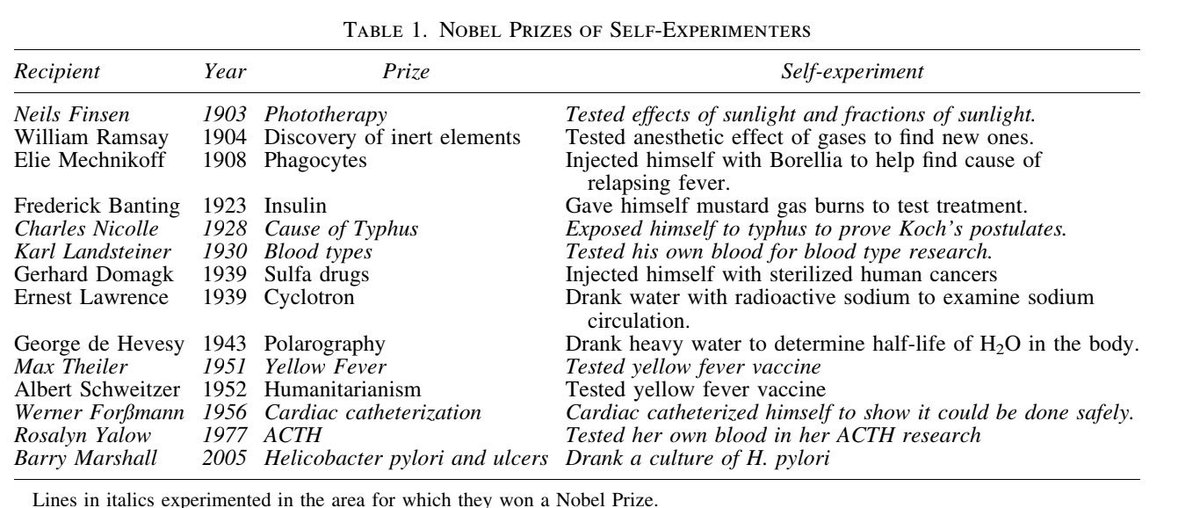
Science began as a creative craft pursued by curious individuals experimenting on a small scale. We forget how many of its landmark discoveries came from people who turned the question on themselves. Nicolle exposed himself to typhus. Forssmann catheterized his own heart. The list goes on (see the image above), and it is not a list of rogue actors. That was the system. Self-experimentation was how you did science when the stakes were personal and the tools were at hand.
The Whole Earth Catalog
Stewart Brand, 1968–1998
Stewart Brand was a Stanford-trained biologist who looked at the world and asked a simple question: what if people had access to everything they needed to think, build, and live differently? The Whole Earth Catalog was his answer. Published from 1968 to 1998, it was part magazine, part manifesto, part toolkit, a sprawling review of books, technologies, seeds, and ideas offered freely under a single slogan: "access to tools." It didn't sell anything. It just pointed people toward what they needed and trusted them to do something with it. That trust was the radical act. Brand believed, before the internet made it obvious, that the gatekeeping of information and tools was not a neutral fact of life but a choice, and that dismantling it would change everything. He was right. Everything that follows in this canon, open-source software, DIY biology, community insulin production, traces its lineage back to the same conviction Brand put into print in 1968: that curious individuals, properly equipped, are more than capable of doing the work that institutions claim as their exclusive domain.
Our Biotech Future
Freeman Dyson, The New York Review of Books, 2007
Freeman Dyson's 2007 essay "Our Biotech Future" contains one of the most memorable predictions about biology I've come across: the domestication of biotechnology will shape the next fifty years at least as much as the domestication of computers shaped the last fifty. The argument is simple but its implications are vast. Powerful tools begin inside large institutions, then gradually become cheaper, easier, and more widely available, until individuals are doing work that once required whole organizations. Biology, Dyson believed, would follow the same arc as computing, moving from big and centralized to small and domestic. That shift will require careful thinking about safety, governance, and responsibility. But it also carries a possibility that is genuinely exciting: biological design becoming something like a creative craft, practiced not only by institutions but by curious individuals experimenting at smaller scales. For a long time that vision felt distant. Now, it feels like we may be seeing the first hints of it.
Guerrilla Open Access Manifesto
Aaron Swartz, July 2008
Aaron Swartz wrote this manifesto at twenty-one years old, and four years later the federal government indicted him on thirteen felony counts for trying to live by it. The argument is simple and it hits like a fist: the world's scientific and cultural heritage has been digitized and locked behind paywalls by a handful of private corporations, and the people with access to that knowledge have a moral duty to share it. Swartz called the criminalization of sharing what it was: not piracy, but the privatization of public culture. He died in 2013, before seeing how far the movement would travel. The manifesto belongs in this canon not just because it is right, but because it demonstrates the stakes. If the knowledge locked behind paywalls is scientific journals, the cost is academic progress. If the knowledge locked behind patents is insulin, the cost is human lives. Swartz understood that the fight over who gets to access information and who gets to control it is the same fight, every time, in every domain. That is why it belongs here.
Open Insulin Foundation
openinsulin.org
The Open Insulin Foundation is the canon's proof of concept, the entry that shows what it looks like when the philosophy leaves the page and enters the lab. A globally distributed team of biohackers across Oakland, Baltimore, Paris, Brazil, Senegal, Cameroon, Puerto Rico, and beyond, they are building the first practical, community-centered model for producing insulin outside the existing pharmaceutical supply chain. Their target is one of the starkest failures of proprietary biotech: insulin prices have risen in lockstep among a handful of suppliers for decades, while hundreds of millions of people depend on the drug to survive. Open Insulin's answer is not to lobby or litigate but to develop open protocols for local production, so that the communities most affected can become their own suppliers. What makes them essential to this canon is not just the goal but the posture, the refusal to wait for institutions to act, and the insistence that life-saving molecules have no business being locked behind patents and monopolies.
The Privacy Manifesto
Zachary Williamson, Substack, 2024
Zachary Williamson's "The Privacy Manifesto" is a diagnostic for a disease that biology is about to catch. The Information Age, he argues, delivered not abundance but a feudal surveillance state, one where a handful of corporations monetize human attention and behavior by turning users into products. The social costs, from algorithmic rage to eroded trust, are not bugs but the intended output of a system optimized for engagement over human flourishing. His proposed remedy runs through zero-knowledge cryptography and privacy-preserving infrastructure: tools that let people prove things about themselves without surrendering their data, transact without feeding information brokers, and reclaim something he calls, simply, human dignity. The essay belongs here because biology is the next frontier of that same extraction. The moment we generate data about our bodies (genomics, wearables, health records), we enter a system with every incentive to commodify it. Building infrastructure that keeps bodily data with the person, provable when needed and never for sale, is not a separate fight. It is the same one.
"I support it only if it's open source"
Vitalik Buterin, August 2025
In "I support it only if it's open source", Vitalik Buterin supplies the normative backbone the other entries circle around but rarely state so plainly, and that is why his essay lands as the canon's closing argument. Where Dyson imagined biology democratizing like computing, and Open Insulin showed what that looks like in practice, Buterin gives us the principle that should govern the transition: if a technology remains proprietary, its benefits flow upward. Open source isn't just a licensing choice. It determines whether radical technologies like life extension or genetic enhancement become tools of liberation or instruments of a new hierarchy. For a movement premised on the idea that bodies and biology belong to people, not corporations, "I will only support it if it's open source" isn't a caveat. It's a precondition.
More pieces in the canon to come.


OPENBODYOPENBODY